25 Apr, 2025 - Corporate Groups

The ABC of Generations Y and Z in the workplace

The ABC of Generations Y and Z in the workplace

The workplace has changed. No longer required to be at our desks for eight hours every day, some people are thriving – while others are floundering.
Younger generations, like Gen Y (more commonly known as millennials) and Gen Z, face challenges their older colleagues never encountered.
Picture the office of the eighties or even nineties. You’d start in a junior position, steadily climbing the ranks, confident that there would be a place for you until retirement. Your world reflected this steadiness. Of course, there was economic, political, and social turmoil. But, by and large, your days were fairly predictable.
Today’s younger employees don’t have that same certainty and their older colleagues may misunderstand them.
Executive coach Justin Hills explains, “Leading today means seeing past generation stereotypes”. Each generation has unique needs, motivators, and communication styles.
Millennials: Entering a brave new world
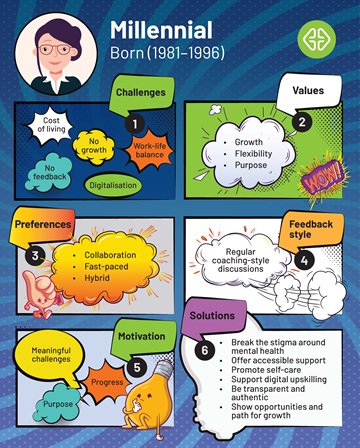
The traditional office changed completely when the internet started to gain traction, coinciding with millennials’ coming of age. Marina Wildt, life coach and founder of the Heal wellness platform, points out that this shift has shaped their worldview, making it bear little resemblance to that of older generations.
This generation has known little stability, especially from an economic perspective. They entered the workplace when economies around the world were crashing, and they’ve never quite felt as though they were on firm ground.
What makes millennials anxious?
Millennials constantly feel that their jobs are under threat, leading to heightened stress and anxiety.
- This generation faces the challenge of skyrocketing costs of living. Many juggle student debt while also paying off home loans, funding their children’s education, and often supporting ageing parents.
- Their greatest workplace competitor isn’t the talented young newcomer; it’s digitalisation. Automation continues to make more roles redundant. As a result, they avoid taking breaks and constantly try to prove their value to the organisation – leading to high stress and unprecedented burnout.
- Despite popular belief, many millennials still struggle with remote work. Their fear of job insecurity drives them to blur work–life boundaries and often work late into the night.
How can we help them?
- Millennials still feel that there is a stigma around mental health and are, therefore, reluctant to speak up if they are experiencing stress and anxiety. Make a point of removing the stigma by encouraging discussions around these issues. This will promote a culture of psychological safety.
- Provide appropriate resources, such as on-site counsellors.
- Encourage the use of self-care tools like meditation.
- Offer training opportunities to help millennials stay current with evolving technologies and support digital upskilling. This will build their confidence, reduce anxiety about job security, and help them feel more in control of their future.
Generation Z: The first digital natives
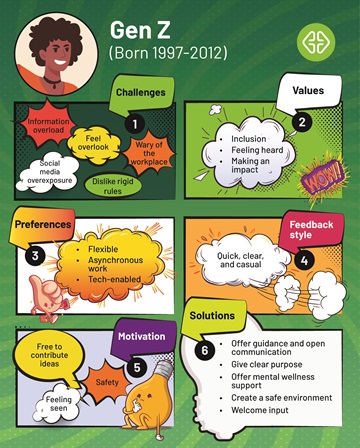
Gen Z is the first generation to have grown up in a world where the internet was present from their very first day – and it shows. Their digital upbringing has shaped their worldview, work habits, and mental well-being in ways that set them apart from previous generations.
What’s keeping Gen Z up at night?
For this generation, feeling overwhelmed is common due to the constant influx of information, insights, and advice. Our brains are not equipped to handle this level of input, and the resulting overwhelm often manifests as stress and anxiety.
- The constant exposure to social media – and its never-ending stream of comments and feedback, often negative – has left them extremely sensitive to criticism of any nature, even if it’s intended to be constructive.
- This generation also saw the struggle their parents and grandparents faced daily, and it’s made them wary of the workplace. This is why they place such a high priority on mental health. They are determined to achieve a better balance.
How to help
- Gen Z is uncomfortable with uncertainty. Ease their concerns by encouraging information sharing. Similarly, provide clarity on their roles and career paths.
- It’s important for Gen Z to find meaning in their careers. Help them by emphasising the value they bring and the contribution they make.
- Respond to their concerns about mental health. Check in with them regularly and provide tools to help bolster mental wellness (and promote their use, as many do not use the resources available). Encourage a sense of community and connection in the workplace.
Food for thought: The stress pandemic
Recent research shows that young workers in the United Kingdom lose around one day a month to mental health issues. In South Africa, the SA Federation for Mental Health reports that 13% of South African employees live with a diagnosed mental health condition, while over one third experience excessive stress on a daily basis. Globally, anxiety and depression cost us around 12 billion working days per year.
These figures are a call to action. The modern workplace is more generationally diverse than ever, and the mental health needs of millennials and Gen Z are distinctly different from those of older generations. Rather than viewing these differences as barriers, we can embrace them as a blueprint for more inclusive leadership. As Hills puts it, “Great leaders learn how each generation thrives.”
Millennials value growth, coaching, and purposeful work. Gen Z seeks inclusion, trust, and the opportunity to make a difference. Both generations want more than a payslip – they want workplaces that see them, support their mental wellness, and invite their voices to the table.
And while employers must foster psychologically safe and supportive environments, personal well-being also depends on each individual’s commitment to self-awareness, growth, and resilience. Encourage younger employees to take ownership of their mental health – whether through self-care, open dialogue, or creative expression – and empower them to thrive, even in uncertain times.